Showing posts with label thoughts. Show all posts

Thursday, May 05, 2016

Thoughts on "All the Light We Cannot See" and Today's Political Climate


I am not going to give a synopsis of this book. This post is not a review, but more a meditation on the book and our current political situation. 

If you're curious about the plot, I urge you to read the book. It's a simply gorgeous novel. Otherwise, Bishop Barron does his usual superb job of explaining the complicated in his beautiful simplicity. Actually, don't read that link after all. There's not much to say after Bishop Barron is finished writing.

Doerr tickled my brain with this book, writing beautiful prose that managed to not be overwrought. Interesting without overwhelming the reader with too many descriptions, flowery verses, or philsophizing (all of which I enjoy, but in good measure). 

The book has several themes, some of the most obvious are the contrasts between light and darkness, sight and blindness. Marie-Laure is blind, but understands human nature better than most. Werner has no such handicaps, but often chooses to overlook darkness in others, refusing to judge lest he be judged (by the school? by the Nazis? by himself?) and found unfit.

Perhaps due to their adolescence or the process of growing up in wartime, but both Marie-Laure and Werner repeat urgent mantras as young adults such as:
“Open your eyes and see what you can with them before they close forever” 
and 
“Don’t you want to be alive before you die?” 
I've been thinking of these mantras, turning them over and over in my head, just as Marie-Laure turned over the wooden puzzle boxes in her hands. I want desperately to respond appropriately to what is going on in our country today. I don't want to be left with regrets like Werner. 

I am tempted at times to feeling it doesn't matter what I do, that I am only one piece of a huge puzzle, with more working parts than I can imagine. I think if this book communicates anything, then it's message of that individuals matter, have incredible worth. We truly have so much light inside that we cannot see. Just as Werner finds hope and redemption in the beauty of Marie-Laure, I look to my children and see good news for the world. The beauty of their light inside, the hope and wonder they display so naively to the world, give me light and courage for my path today. 

I am just one person, but I am a lamp to my children and they are watching me. They may be the ones to change the world when it is their time. So I must do my part now.
“All your life you wait, and then it finally comes, and are you ready?”

Tuesday, July 22, 2008

The Last Lecture

I am in the midst of reading Randy Pausch's book, The Last Lecture. In many ways it is a quick read, written in a conversational style. However, this book should not be a quick read. It should be eaten slowly so one might savor every bite. It contains the life stories and life lessons of an incredibly inspiring man.

The author, Randy Pausch, was diagnosed with Pancreatic Cancer; he was given three to six months of health in late August 2007. Pausch was a well-known professor at Carnegie Mellon prior to his diagnosis. After much consideration, Pausch decided to give a last lecture at Carnegie Mellon which was the inspiration for the book. The Last Lecture is full of inspiring wisdom and strength. I can't say enough about the book; suffice it to say that I heartily recommend The Last Lecture.

Here are a few of my favorite quotes from the book:
"Experience is what you get when you didn't get what you wanted. And experience is often the most valuable thing you have to offer."
"Brick walls are there for a reason. They give us a chance to show how badly we want something."
"Time is all you have. And you may find one day that you have less than you think."
"Everyone of us must decide: Am I a fun-loving Tigger or am I a sad-sack Eeyore?"

Pausch was invited to give the charge to graduates at Carnegie Mellon this year. Here is his speech, courtesy of Youtube and Carnegie Mellon.

Saturday, July 19, 2008

Book Review: Offbeat Bride

I just finished reading the book Offbeat Bride: Taffeta-Free Alternatives for Independent Brides by Ariel Meadow Stalling. I was excited to read the book as I enjoy the Offbeat Bride website. However, I found the book rather disappointing. I was hoping that this book would provide ideas for brides who don't want a McWedding. However, most of the book is simply Stalling's sharing about her own wedding experiences. Having recently become engaged and started the search for various wedding paraphernalia, I understand Stalling's distaste for the Wedding Industry and the cookie cutter wedding/reception. However, I do not agree with the author's approach to the independent wedding. Perhaps it is simply a personality clash. Unlike Stallings, I do not intend my wedding to be a symbol of my declaration of independence from the self-proclaimed sovereign Wedding Industry (or society). In my opinion, weddings should be a communal, joyful celebration which binds the community together. The author does not promote good communication skills among brides and their families; she encourages brides to hide details that their families might find offensive until the day of the wedding. While I believe that couples should plan weddings and reception that reflect their personal interests and beliefs, they should not at the cost of distancing their loved ones. The "F--- you" approach to weddings (and life in general) can only get you so far. (That being said, the level of cursing in this book is distracting and irritating.) Basically, I think Stallings encourages a Bridezilla approach to alternative weddings.


Thursday, March 01, 2007

I have recently been reading T. S. Eliot’s essay Tradition and the Individual Talent. The essay discusses the connection between the concept of tradition and innovation in the arts. I especially liked this passage:

“To conform merely would be for the new work not really to conform at all; it would not be new, and would therefore not be a work of art…. But the difference between the present and the past is that the conscious present is an awareness of the past in a way and to an extent which the past's awareness of itself cannot show….” (5, 6)

This part of the essay reminded me of what my friend Alex had been telling me about Ara Pacis, an example of very modern architecture in Rome. Ara Pacis is a stark white, geometrical building surrounded by the many warm-colored buildings along the Tiber. It had been argued that the building does not match its surroundings. Seen through the context of Eliot’s Tradition and the Individual Talent, Ara Pacis is actually “traditional” in the fact that it breaks the conventional mold.

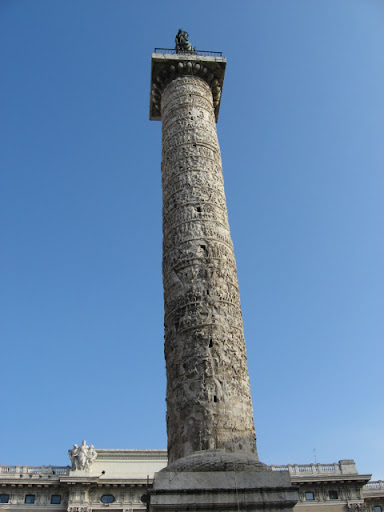
Another facet of this dualistic thinking is the mix of Christianity and Roman symbols throughout the city. Many of the Roman monuments were Christianized during the Middle Ages when the popes were trying to erase the pagan memorials. The home of the Mother Church was built upon the great pagan city. Roma celebrates the synthesis the old within the new, the pagan within the Christian. The above picture is an ancient obelisk with a statue of (what I believe) is St. Peter on top. This illustrates what Eliot described as “This historical sense, which is a sense of the timeless as well as of the temporal...together, is what makes a writer [or any artist] traditional..” (3)

“No poet, no artist of any art, has his complete meaning alone. His significance, his appreciation is the appreciation of his relation to the dead poets and artists.” (4)

Some musings from a hopeful traditional…

For pictures of Ara Pacis, click here.
To read Tradition and the Individual Talent, click here.